Wednesday, May 11, 2016
20 Time Reflection
I challenged myself by becoming the best blogger and a researcher I could be, meanwhile learning and applying tips about healthy lifestyles. I wanted to extend my skills from biology blog into a real life blog that could actually inform people. I chose this challenge because I play a lot of team sports, and myself and the team all have complained about not eating good food at least once. My goal was to inform high schools athletes about how they can help their bodies when they play any sport or activity. Taking care of your body is very important and the first step to that is education. My main focus was to learn and teach others through a blog. My plan was to create the blog then spread the word about it with my teams or social media. This would create a larger audience and help more people. This project just got started, meaning the foundation of it is sturdy but there are not many posts. It took me a while to come up with a name, make my own logo, and plan out the themes of my future posts. I spent too much time trying to perfect the brand of the blog and ran out of time with the actual blogging, which is the most important part. I learned that I need to set my priorities of projects, like letting go on unimportant parts to accomplish the bigger parts. I was too excited about the many topics my blog would entail and instead should have committed to one to write. If I could do it again, I would write my posts first then start the jazz up the blog site. I would like to continue this project and learn more nutrition for myself and also for my team. I would like to have more posts for it to feel more complete.

Thursday, May 5, 2016
Unit 9 Reflection!
This unit covered what we define as life and how we separate different organisms. Groups are based on similarities to each other. Taxonomic levels divide large groups into smaller and smaller and they still change. The order is kingdom, phylum, class, order, family, genus and species (Kings Play Chess on Fine Grained Sand). Phylogeny shows the evolutionary history of an organism and its common ancestors, basically the roots from which it came from.
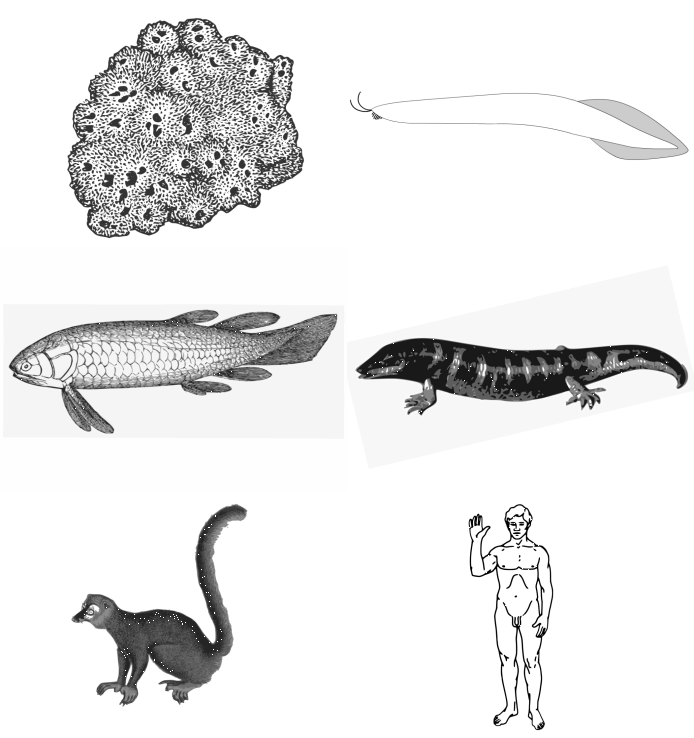
This GIF really shows how life changed from each species, adding new traits to survive and thrive. Unit 9 could really be summarized by the famous picture with the tree of life, it goes narrow to broad. There are 4 man kingdoms: protista, plants, fungi, and animals. Bacteria are in the domain prokarya, they are Earth's first organism. They come in 3 shapes: cocci, bacilli, and spirals. They can be classifed by their cell wall that is gram postitive or negative. Viruses are not really living things, but instead a small infectious particle. Fungi are decomposers and come in 3 groups: sac fungi, club fungi and bread molds. Like animals, plants started in water and evolved through natural selcetion, using the same ideas that we learned in evolution labs. Bryophyta are seedless and non vascular, like moss. Pterophyta are seedless vascular plants and have roots. Gymnosperms bear cones and angiosperms have flowers.

Animals are diverse but still share characteristics. 97% of species are invertebrates. Sponges are the most primitive and have no symmetry. There are 4 main classes: scyphozoans(jellies), anthozoans(coral), hydrozoans(hydra), and cubozoans(box jellies). There are 5 groups of arthopods: trilobites, crustaceans, chelicerates, insects, and myrapods.

All vertebrates have similar characteristics, like notochords, hallow nenechords, paryngeal slits, and a tail. Fish are divided into condricthyes and osteoictheyes. Reptiles are diverse group of amniotes who have dry scales, are ectotherms, and a 3 chamber heart. They are divided into turtles and tortoises, snakes and lizards, crocodilian, and tuatara. The class aves are from therapod dinosaurs, and they have hallow bones, fused wishbone, and "hands" with 4th or 5th finger. In the video we watched in class, "Your Inner Fish", we learned about the discoveries in fetus that led to the fused wishbone and middle ear. The last class mammalia have 4 main cahracteristics, hair, mammary glands, middle ear, and strong jaw. They reproduce by either being a monotreme, marsuprial, or eutherian.
I want to learn more about the bacteria and archea domains because the eukarya has so many species and types but the others still seem like a mystery. I wonder about what types of organisms have not been classified yet or even discovered. There are some documentaries about new discoveries that I have heard of and look very interesting.
I thought that my WEE went well and I am proud of the work that I did. I learned a lot of new facts and big words that were very hard to pronounce. My biggest problem was speaking too fast and calming down when speaking to the class. I was nervous because I was really hoping that I would get my information out without staring at my screen and also not to bore the students. Next time, I will do the same way of knowing my presentation very well but I will teach the class in a more conversational way.
This GIF really shows how life changed from each species, adding new traits to survive and thrive. Unit 9 could really be summarized by the famous picture with the tree of life, it goes narrow to broad. There are 4 man kingdoms: protista, plants, fungi, and animals. Bacteria are in the domain prokarya, they are Earth's first organism. They come in 3 shapes: cocci, bacilli, and spirals. They can be classifed by their cell wall that is gram postitive or negative. Viruses are not really living things, but instead a small infectious particle. Fungi are decomposers and come in 3 groups: sac fungi, club fungi and bread molds. Like animals, plants started in water and evolved through natural selcetion, using the same ideas that we learned in evolution labs. Bryophyta are seedless and non vascular, like moss. Pterophyta are seedless vascular plants and have roots. Gymnosperms bear cones and angiosperms have flowers.
Animals are diverse but still share characteristics. 97% of species are invertebrates. Sponges are the most primitive and have no symmetry. There are 4 main classes: scyphozoans(jellies), anthozoans(coral), hydrozoans(hydra), and cubozoans(box jellies). There are 5 groups of arthopods: trilobites, crustaceans, chelicerates, insects, and myrapods.
All vertebrates have similar characteristics, like notochords, hallow nenechords, paryngeal slits, and a tail. Fish are divided into condricthyes and osteoictheyes. Reptiles are diverse group of amniotes who have dry scales, are ectotherms, and a 3 chamber heart. They are divided into turtles and tortoises, snakes and lizards, crocodilian, and tuatara. The class aves are from therapod dinosaurs, and they have hallow bones, fused wishbone, and "hands" with 4th or 5th finger. In the video we watched in class, "Your Inner Fish", we learned about the discoveries in fetus that led to the fused wishbone and middle ear. The last class mammalia have 4 main cahracteristics, hair, mammary glands, middle ear, and strong jaw. They reproduce by either being a monotreme, marsuprial, or eutherian.
I want to learn more about the bacteria and archea domains because the eukarya has so many species and types but the others still seem like a mystery. I wonder about what types of organisms have not been classified yet or even discovered. There are some documentaries about new discoveries that I have heard of and look very interesting.
I thought that my WEE went well and I am proud of the work that I did. I learned a lot of new facts and big words that were very hard to pronounce. My biggest problem was speaking too fast and calming down when speaking to the class. I was nervous because I was really hoping that I would get my information out without staring at my screen and also not to bore the students. Next time, I will do the same way of knowing my presentation very well but I will teach the class in a more conversational way.
Wednesday, May 4, 2016
Your Inner Fish Review
In the "Your Inner Fish"video, we were taught about how fish came onto land and how they eventually evolved more amphibian-like traits, such as hind legs for walking. It went over how many of our characteristics evolved from them and the physical characteristics which we adapted to own. This series not only taught me about the evolution of man kind but how we fit into the grand idea of earths history.
"What is significant about the master gene EDA?" Master gene EDA is the gene that controls all of our skin organs such as teeth, hair and feathers. It helped to connect all animals as this gene is present in all species and develops some of our most defining characteristics. It connects to our unit about genes since it shows the regulation of genes and traits, but also about how this gene has survived natural selection and evolution to allow us human beings to evolve."Why are mass extinctions important?". Mass extinctions pave the way for new species to rise.

For example, after the dinosaurs ruled the earth all throughout the Triassic, Jurassic, and
Cretaceous eras, the mass extinction 65 million years ago wiped them all out, creating a new niche for mammals to cover. This extinction was essential for the continuation of mammals as a species, and eventually our success, since we evolved from the earliest mammals that emerged after the extinction.
"What is significant about the master gene EDA?" Master gene EDA is the gene that controls all of our skin organs such as teeth, hair and feathers. It helped to connect all animals as this gene is present in all species and develops some of our most defining characteristics. It connects to our unit about genes since it shows the regulation of genes and traits, but also about how this gene has survived natural selection and evolution to allow us human beings to evolve."Why are mass extinctions important?". Mass extinctions pave the way for new species to rise.

For example, after the dinosaurs ruled the earth all throughout the Triassic, Jurassic, and
Cretaceous eras, the mass extinction 65 million years ago wiped them all out, creating a new niche for mammals to cover. This extinction was essential for the continuation of mammals as a species, and eventually our success, since we evolved from the earliest mammals that emerged after the extinction.
Wednesday, April 20, 2016
20 Time Blogging Progress
I have learned a lot of what to eat before physical activity. It is very helpful for myself while a research it and I hope it can be just as useful for others when I post it. I learned that I am interested in this subject but need to pick a layout for all future posts to the blog. One setback would be not being here for 20 time in class because it is hard to find time to work on it. My next steps are to start posting and creating an educational archive full of different topics. I can help be feeding myself better and advising my team with the best tips.
Friday, April 15, 2016
Haliclystus antarcticus
The phylum of the Haliclystus antarcticus is cnidaria, the order is Stauromedusae and the family is the Lucernariidae. It is called a stalked jellyfish because it has a stalk-like band of neurons that is divided into four chambers. It has 8 arms that radiate in pairs, giving it radial symmetry. Each of those arms has 200 tentacles that is coated in the stinging cell cnidocyte. It was discovered in Antarctica but there has been reported sightings found in Argentina and Chile. I wonder why the organism can be found in both drastic climates. 
Tuesday, March 29, 2016
The Beginning of Research
Now that I am done with the making of my blog, I will begin to start writing my content and posting it every 2 weeks. I learned a lot more about how to customize blogger to organize things in the way that I want. I learned that it takes me a while to finalize the design because I always see the things that need improving. It is sometimes hard to use blogger because there are few templates and they are not what I had in mind so I've struggled to make them different. My next steps are to research the topics that I have already chosen. I can use this experience for whenever else I need to make a creative blog.
Friday, March 25, 2016
Unit 8 Reflection
This Unit was about evolution and how things affect a population over time. Natural selection is a tool of evolution and it changes the allele frequency of a gene pool. Natural selection favors certain traits and those are passed on to offspring. Darwin said that there are winners and losers and the population starts to look like the winners.
 This was demonstrated in the Bird Beak Lab. Speciation is the rise of 2 or more species from 1 existing species. This can be caused by behavioral isolation, as seen from the Hunger Games Lab when knucklers only wanted to mate with other knucklers, geographic isolation, and temporal isolation. There is a lot of proof of evolution such as vestigial structures, which are the evolutionary leftovers of ancestors and fossils which are a big piece of evidence. Fossils can do relative dating, homologous structures, and analogous structures. The earth is extremely old and amino acids have been found in meteorites giving the idea that RNA monomers have been made spontaneously from molecules.
I want to learn more about the proof of evolution and other theories because it is like solving the mystery of time and there are many creative theories. How did we gather this information about the different eras and epochs from fossils? I wonder about how much time the earth was empty and what the development of humans looked like. What are the drastic events that led to life on land, plants, and everything else.
I was ranked as being assertive, but I need to fix my collaborative skills. It's much better once everyone gets involved in a project, rather than one person taking control and making everyone do their tasks. It is very important to find a perfect blend of being assertive, but also being a good leader, and making sure everyone feels that their ideas are felt.
Subscribe to:
Posts (Atom)